
Manufacturing Scope or Coordination Work? Two Ways Fragrance Buyers Work
A fragrance programme can be bought as a scope or coordinated as a project, and the two are genuinely different jobs. Buying scope means one partner is accountable for compounding, filling, packaging and the records that go with them. Coordinating means the brand keeps control of each piece and carries the interfaces between them. Neither is better in the abstract; the question is whether the team has the time, the technical judgement and the appetite to own the handoffs.
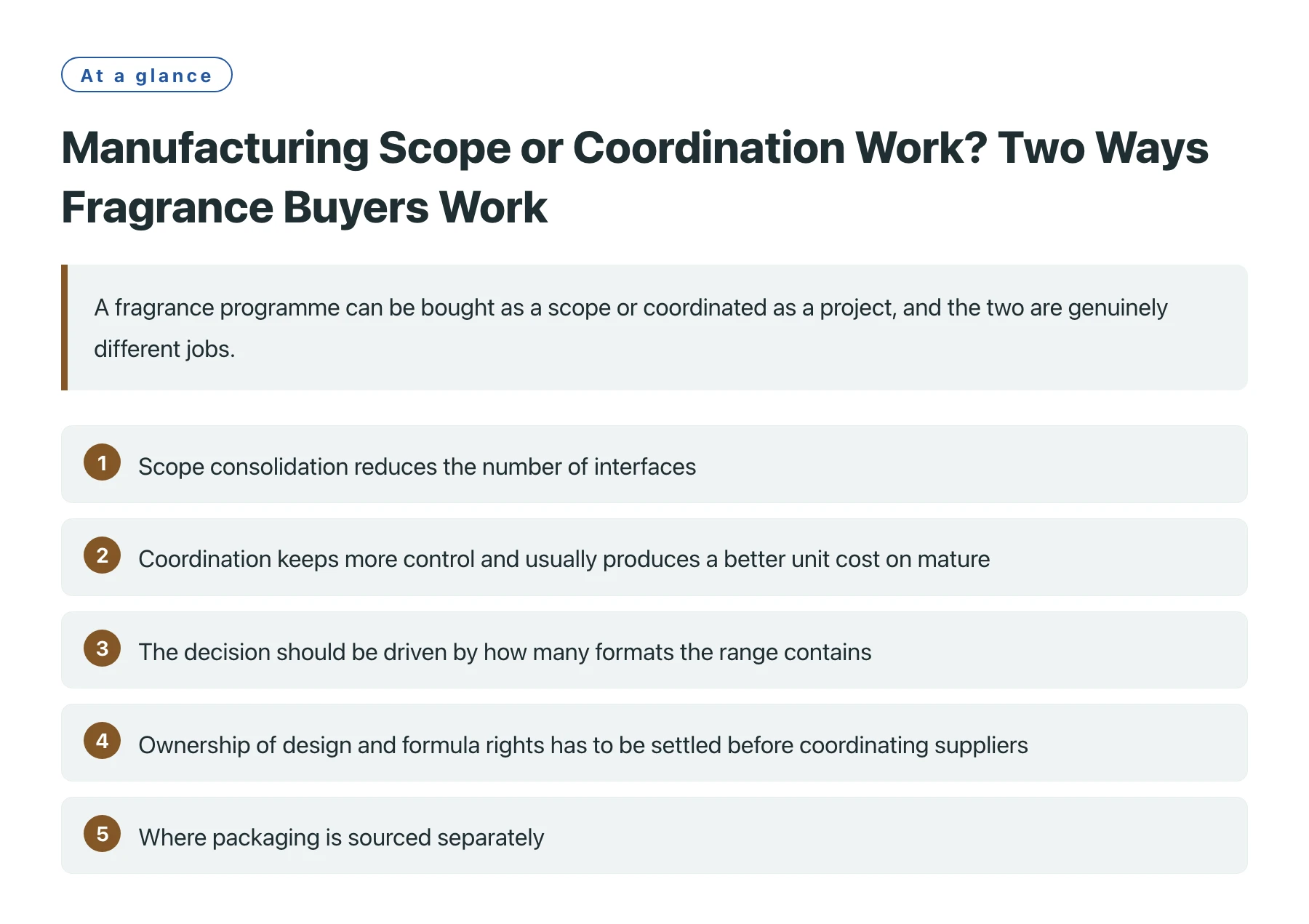
Key takeawaysScope consolidation reduces the number of interfaces, and interfaces, not individual suppliers, are where most launch delays originate. · Coordination keeps more control and usually produces a better unit cost on mature, high-volume ranges, but it is paid for in project management time. · The decision should be driven by how many formats the range contains, because each additional format multiplies the interfaces rather than adding to them. · Ownership of design and formula rights has to be settled before coordinating suppliers, since a split supply chain shares drawings, specifications and formulations between parties [1]. · Where packaging is sourced separately, sustainability claims and material declarations become the brand's responsibility to assemble and defend [2]. · Market expectations are a further input: ingredient, labelling and packaging obligations differ by destination, and someone in the chain has to own that file [3].
Most sourcing conversations about fragrance manufacturing are really conversations about scope, even when nobody uses the word. A brand asks whether to work with one partner for everything or to assemble the best supplier for each element, and the answer is usually framed as a cost comparison. Cost matters, but it is not the deciding variable for a premium launch.
The deciding variable is the number of interfaces the team is willing to manage. Every additional supplier adds a specification that has to be handed over, a schedule that has to be aligned, a quality standard that has to be reconciled and a party that has to be chased when something slips. Scope consolidation removes those interfaces by making one party responsible for them.
The comparison below sets out the two approaches on the dimensions that actually differ, followed by a short sequence for deciding where a particular programme should sit.
The two routes, honestly described
Buying scope means handing one partner the brief and receiving a finished, configured product with the records attached. The advantage is not that the partner does everything, because it often does not: decoration and some components may still come from third parties. The advantage is that the partner owns those relationships and the specification flow between them.
Coordinating means the brand acts as the integrator. It may buy fragrance from one house, bottles from a second, decoration from a third and filling from a fourth, then manage the sequencing itself. This is entirely workable and is how many experienced brands operate, particularly once volumes justify it. It requires, however, that someone on the brand side has the technical vocabulary to arbitrate between suppliers when a specification is ambiguous.
Where each route fails
Consolidated scope fails when the partner's capabilities are assumed to be broader than they are. A brand can discover late that decoration is outsourced, that a specific pack format is not available, or that a market's labelling expectation sits outside the partner's routine. The remedy is to establish the true scope early, in writing, including what is excluded.
Coordinated supply fails at the interfaces. A bottle that meets its own specification may still not accept the pump, and a fragrance approved in one context may behave differently when filled on a line that has its own process settings. These are integration problems, and they appear at exactly the point in the schedule when there is least time to solve them.
Both failure modes are manageable, and both are cheaper to address with a written scope than with a meeting. The practical question for a brand is which set of failures its team is better equipped to catch. A partner that keeps development and production together, with Xuelei Fragrance, removes one specific class of interface, though it does not remove all of them.
The parts that are easy to overlook
Intellectual property is the first. When several suppliers hold pieces of a product, drawings, moulds, specifications and formulations travel between them, and the ownership of each element needs to be clear. Design and formula rights are assets, and their registration and assignment are ordinary commercial work rather than legal arcana [1].
Packaging documentation is the second. Material claims, recycled content and recyclability statements rest on data from whoever produced each component, and a brand assembling a range from several sources has to collect and defend that data itself [2]. A consolidated partner is affected by the same obligations but is easier to hold to them.
Market-facing obligations are the third. Labelling, ingredient declarations and market-specific expectations do not disappear when the supply chain is split; they simply move to whoever agreed to own them. In practice, brands in Europe work within a dense set of expectations that apply to the finished product rather than to any single component [3]. Published project material, including the range of products behind brands Xuelei has manufactured for, is a quick way to see which route tends to be chosen at a given range size.
The trade-offs, side by side
| Dimension | Buying consolidated scope | Coordinating several suppliers |
|---|---|---|
| Number of interfaces the brand manages | Few, with the partner absorbing supplier relationships | One per element, plus the sequencing between them |
| Unit cost at maturity | Usually higher, because the partner carries coordination costs | Often lower at volume, once the brand's own time is excluded from the sum |
| Speed on a first order | Faster, because specification flow is internal to one party | Slower, because each handover is a new alignment |
| Quality accountability | Single point of accountability for the finished product | Split, and the brand arbitrates when specifications conflict |
| Records and compliance file | Assembled by the partner from its own production data | Assembled by the brand from data supplied by each party |
| Sensitivity to a single supplier's limits | High: the partner's capability ceiling is the programme's ceiling | Low: elements can be replaced individually |
| Best fit | Ranges with several formats, tight calendars, smaller teams | Mature high-volume lines with an experienced in-house technical lead |
The table makes an important pattern visible: the routes differ mainly in where the interface work sits, not in how much of it exists. Consolidated scope moves it inside a partner; coordination keeps it in the brand. A team deciding between them is really deciding whether it wants to own that work. Where the answer is genuinely unclear, being explicit about what a partner includes is the right first step, and the scope published by an experienced Xuelei OEM manufacturing operation is a useful reference point for what the consolidated version normally covers.
A short sequence for deciding scope
- Count the formats, not the products.One scent in one format is a simple programme. One scent across four formats, or four scents in one format, changes the interface count substantially, and the arithmetic usually points towards consolidation for a first launch.
- List what the brand genuinely wants to control.Some teams care about a specific component supplier, a particular decoration method or a custom mould. Anything on that list belongs outside the consolidated scope by design, not by accident.
- Identify who owns each record.For every document the launch needs, name the party that produces it and the party that holds it. Unowned records are the most common reason a first order stalls at the artwork stage.
- Price both routes including internal time.Coordination looks cheaper on a quote sheet and costs project management hours that never appear there. Estimate them honestly, then compare against the consolidated price.
- Confirm the partner's true scope in writing.Ask precisely what is done in house and what is bought in, because the answer determines the interfaces the brand will inherit if it chooses a partner such as Xuelei for the consolidated route.
- Review the decision after the first order.Scope decisions are not permanent. A programme that starts consolidated can split later when volumes justify it, and a split programme can consolidate when a launch date becomes the binding constraint.
Sources
- WIPO — World Intellectual Property Organization —— The UN agency for intellectual property; resources on industrial design and patent protection relevant to product and packaging design.
- Sustainable Packaging Coalition —— A membership organisation working on more sustainable packaging design, publishing material and recyclability guidance.
- Cosmetics Europe —— The European trade association for the cosmetics and personal care industry, publishing guidance, positions and market information.
Frequently asked questions
Is consolidated fragrance manufacturing always more expensive?
The unit price is usually higher because the partner carries coordination, procurement and quality costs that a coordinated supply chain pushes elsewhere. Whether the total is higher depends on how the brand values its own project management time and on how much interface risk it avoids. For a first launch, the comparison usually favours consolidation once internal time is counted.
When does it make sense to split the supply chain?
When volumes are stable enough to justify managed relationships, when the brand has in-house technical capability to arbitrate specifications, or when a specific element, such as a bespoke component or a particular decoration, simply cannot be sourced through one partner. Splitting for marginal unit-cost savings alone rarely pays for the added management work.
Who owns the compliance file in a split supply chain?
The brand, in practice, because the file describes the finished product and no single supplier sees all of it. The practical mitigation is to assign each document to a named owner at the start and to keep a single register, so that gaps are visible before the artwork is finalised rather than after.
How many suppliers is too many for a first launch?
There is no fixed number, but the useful test is whether the team can describe each handover without consulting notes. If the answer is no, the programme has more interfaces than it can manage, and either the scope or the calendar should change.