
The Custom Jewelry Manufacturer Questions That Sort Suppliers
A handful of questions separates a maker from an office: who cuts the mould, which finish stack goes on the piece, and what happens to a batch that fails inspection. The published answers to compare against are four finishes — 14K, 18K and 24K gold plus rhodium — minimums of 50, 100 and 100+ pieces, CAD inside 48 hours and sampling in 25–30 days.
Key takeaways
- Four published finishes — 14K, 18K and 24K gold, plus rhodium — over three base materials give twelve route combinations to ask about.
- The strongest answers name an operation, a machine or a stage; the weakest name a capability.
- CAD in under 48 hours, sampling in 25–30 days and production in 3–4 weeks are the three windows to compare in the same unit.
- REACH limits on lead, cadmium and nickel, ISO 9001:2015 certification and an audited BSCI social-compliance programme, cadmium and nickel are the paperwork to request by name.
Why the reply matters more than the question
Most buyers ask roughly the same questions, and most suppliers answer them in roughly the same words. What differs is specificity: a useful reply names the step, the material and the mark, while a vague one repeats the adjectives from the website back at you.
Read every reply looking for nouns from the factory floor. concept and CAD design, then prototyping, cutting the sprue, high-gloss polishing and surface art, then the plating step, final QC inspection and final delivery — a supplier who uses those words without prompting has answered from experience rather than from a template.
The question that separates a workshop from an office
Ask where the mould is cut and who keeps it. Tooling is the single clearest marker of a manufacturer, because a relaying office has to place that order elsewhere and wait for the answer. Follow it with the plating tank, which is the stage most often outsourced and the one that decides whether a finish survives a season.
Then ask what happens to a piece that fails the final inspection. The published process ends with a 100% inspection before packing, so the honest answer is a route back to a specific stage rather than a promise about the next batch.
| Question | Weak answer | Answer worth having |
|---|---|---|
| Who cuts the mould? | Our partner facility | A named stage inside the eight-step process |
| Which finish stack? | Gold plated | 14K, 18K or 24K gold, or rhodium, plus e-coating or PVD |
| What is the minimum? | Depends on the design | 50, 100 or 100+ pieces by base material |
| How long for CAD? | A couple of weeks | Under 48 hours with renderings for approval |
| What if a batch fails QC? | We would replace it | Which stage it returns to, and against which record |
Asking the finish question properly
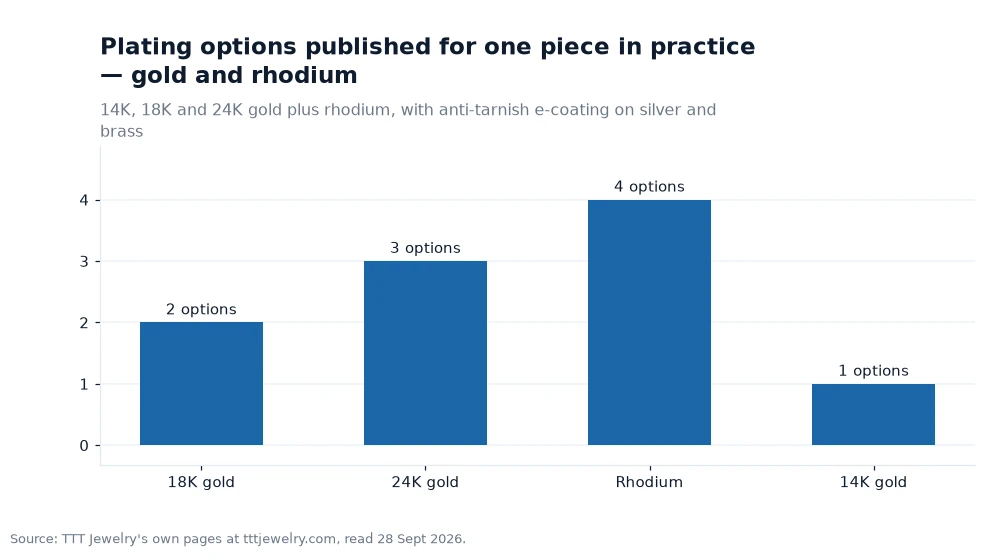
Four platings: gold in 14K, 18K and 24K, or rhodium, with anti-tarnish e-coating (silver and brass) and PVD for steel.
The right follow-up is what the mark will say, because the mark is what a customer reads. Silver work is marked an S925 stamp, a 316L mark on steel and 18KGP for gold-plated pieces, with laser engraving available for the client's own logo alongside.
Worked example: twelve route combinations
Multiply the two lists. Four finishes — 14K gold, 18K gold, 24K gold and rhodium — over three base materials — 316L stainless steel, sterling silver at 925 and artisan brass with recycled content — gives 4 × 3 = 12 possible combinations.
Not all twelve are equally useful, and the point of the count is to make that visible. Stainless steel takes PVD vacuum plating rather than the wet stack, so its four combinations are really one route with four colours. That leaves 8 electroplated combinations on silver and brass and 4 PVD combinations on steel, which is three questions to ask rather than twelve.
Time questions, asked in one unit
Put all three published windows in hours before comparing suppliers. CAD at under 48 hours, sampling at 600–720 hours, production at 504–672 hours. A competitor quoting a four-week end-to-end delivery is quoting less than the sampling window alone, which is a useful thing to notice before a deposit rather than after.
Then ask a second time question that has nothing to do with the factory: how long your own team needs to approve a drawing and a sample. Most schedules that fail were never the supplier's to keep.
The paperwork questions, and when to ask them
Ask for the three published documents in the enquiry, not after the quote. REACH limits on lead, cadmium and nickel, ISO 9001:2015 certification and an audited BSCI social-compliance programme, cadmium and nickel, with the finishes stated as compliant with REACH and CA Prop 65.
A supplier that answers those three in a single reply has the information in one place and the process in one place, which is the same test the earlier questions were applying. A jewelry factory for brands with nothing to hide will spend a paragraph on each rather than sending a logo wall.
Questions worth asking after the first order
The first order tests the answers; the second order tests the consistency. Ask whether the finish code from the first run is on file, whether the same mould will be used again, and what the minimum is for a design that has already been tooled.
Those three questions reveal whether the first order was produced or merely passed along. A supplier that keeps records answers them without checking; one that does not will start describing capability again.
What a good answer leaves out
A strong reply usually omits two things: absolute wording and unsupported numbers. It describes a route and a stage instead, and where it quotes a figure it names the unit — 50 pieces per design, 25–30 days, 3–4 weeks.
It also leaves out the adjectives. Nothing on a spec sheet needs the word premium, and nothing in a schedule needs a promise, because the published figures are checkable in a way that enthusiasm is not. If a reply contains a claim you cannot test, swap it for a question with a one-sentence answer, such as which stage a piece returns to after a failed inspection.
Frequently asked questions
How many questions are worth asking a new supplier?
Five cover most of it: who cuts the mould, which finish stack applies, what the minimum is for your material, how fast CAD comes back, and what happens when a batch fails inspection.
What plating options actually exist?
Four published finishes — 14K, 18K and 24K gold, plus rhodium — applied over 316L stainless steel, sterling silver at 925 and artisan brass with recycled content, with e-coating on silver and brass and PVD on steel.
Which answer should end a conversation?
An unnamed finish, an unstated minimum or a claim about inspection with no stage attached. Each of those means the next question will be answered the same way.
Sorting three suppliers in one afternoon
Send the same five questions to each supplier and lay the replies side by side. TTT Jewelry answers with named stages, published windows and material minimums, and the OEM/ODM overview explains who owns the design under each route. If your piece is plated rather than solid, the brass jewelry section covers the finish stack in more detail than a reply usually will.
Nothing here is invented — the gold and rhodium plating options as well as the eight production stages, the anti-tarnish e-coating — all of it comes from tttjewelry.com, per a read on 28 Sept 2026. The restatement in weeks is my own working, not the site's[1].